
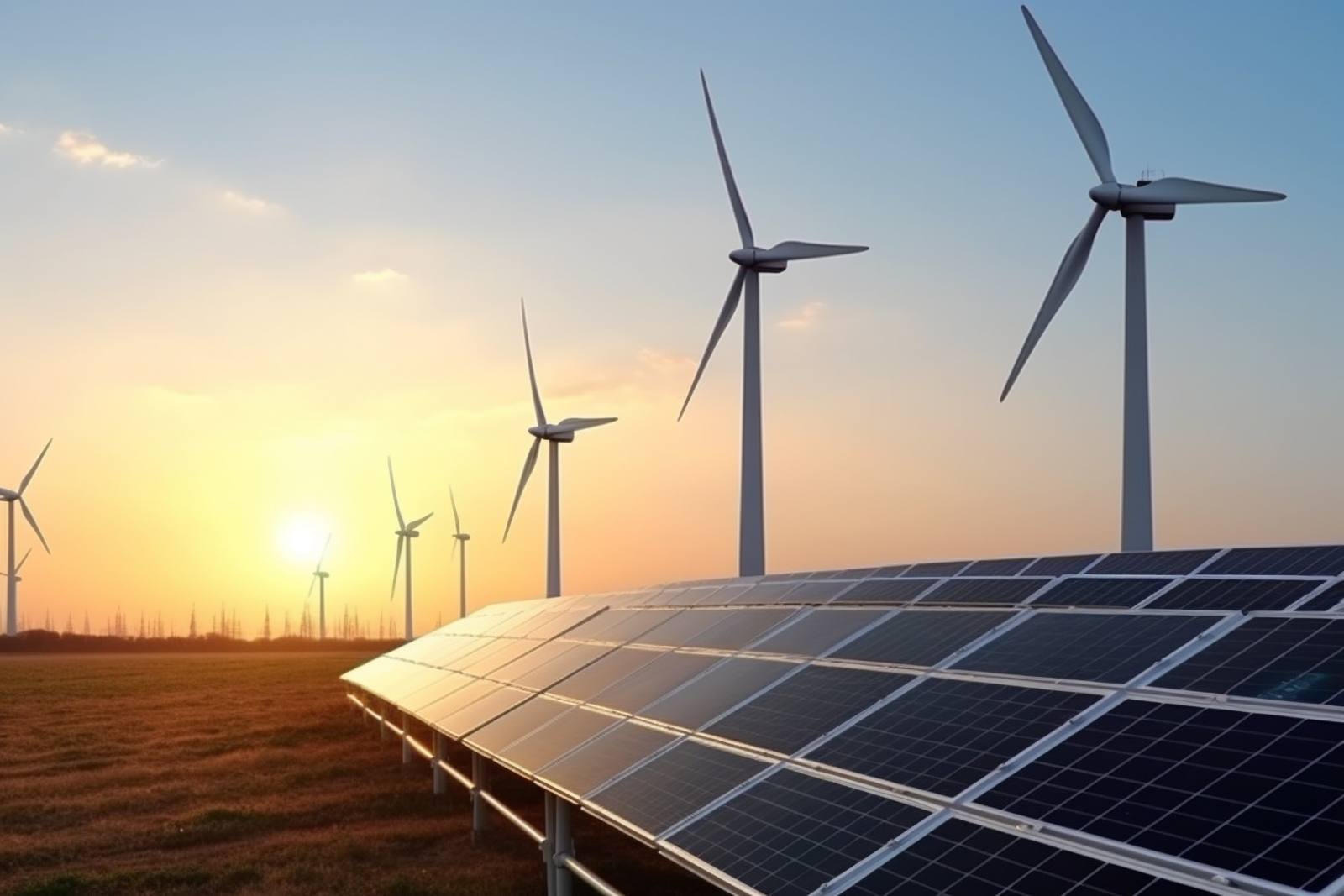
Battery storage for wind farms: store wind power instead of curtailing it

Made in Germany
Engineering, production and service in Germany

Everything from a single source
Planning, engineering, construction and operation

Experienced team
Engineers with years of experience in energy infrastructure

In-house control & EMS
Maximum control and flexibility

Plug & Play
Turnkey, quick to integrate, maximally reliable
When the wind is blowing strongly but the power grid is overloaded, wind turbine operators face financial losses due to curtailed feed-in. Battery storage for wind farms protects revenue by temporarily storing surplus energy and only releasing it when market prices are attractive. GEPVOLT builds storage solutions tailored to the respective generation profile - regardless of whether it is a newly planned project or an existing installation. This technological addition makes operators more independent of congestion and noticeably increases the value of the installation as soon as regular grid overloads or negative exchange prices occur.
Operating a solar park? Battery storage for solar parks
Starting point
Why wind farms lose revenue
Two effects regularly cost wind farm operators revenue: curtailment by the grid operator and negative electricity prices on windy days.
Curtailment due to grid congestion
As soon as local power grids can no longer absorb the wind power generated, grid operators intervene by curtailing output. Valuable energy is lost through the reduced feed-in capacity. A storage system directly at the grid connection point captures this peak output and stores it, so that the rotors can continue to turn profitably.
Negative electricity prices when there is plenty of wind
A strong wind supply combined with weak demand regularly leads to price falls on the power exchange, down to negative values. Anyone feeding in during this phase pays for production in the worst case. With a connected energy storage system, the energy produced is held back until the market has recovered and positive revenues are possible again.
Co-location
Battery storage at the wind farm: co-location and retrofitting
Integrating a storage system pays off in different project phases. GEPVOLT develops the right concept for every scenario.
Storage at the existing grid connection point
With co-location, the wind turbine and the battery share the same grid connection. This dual use of existing infrastructure can reduce the effort for construction cost subsidies and simplify the approval process, as the existing grid connection is used (GEPVOLT agrees the exact requirements with the grid operator in advance).
Retrofitting existing wind farms with storage
For wind farms that are already connected to the grid, retrofitting represents a strategic upgrade. Above all, sites that are frequently affected by curtailment or are approaching the end of their EEG subsidy open up urgently needed new sources of income through storage. GEPVOLT integrates the storage technology in such a way that the ongoing power production of the existing installation is not disrupted.

Revenue
More revenue from the wind farm through storage
For wind turbines, the investment in large-scale storage pays off by bundling various revenue streams that go beyond simply avoiding curtailment.

Feeding in wind energy with a time delay and profitably
Through energy shifting, energy is held back in the battery storage system during periods of low or negative exchange prices. When demand in the grid rises, the stored electricity is sold on much better terms. Generation and marketing are thus decoupled in time and optimised economically.
Additional revenue from grid services
As wind generation naturally fluctuates, power grids depend on constant stabilisation. A battery storage system can offer ancillary services such as balancing power here. On request, GEPVOLT handles the connection to the balancing power market, creating a reliable source of income that works independently of the current wind yield and at the same time contributes to regional grid stability.
Design
Designing the battery storage system in MW and MWh
Every wind site has its own generation and weather characteristics. For this reason, GEPVOLT plans individual storage concepts that match the topography and wind resource of the respective project exactly.
Tailor-made sizing instead of a standard solution
The exact matching of storage capacity (MWh) and charging and discharging power (MW) is based on historical generation data. The specific wind profile of the turbines, the actual curtailment losses and the capacity limits at the grid connection point are analysed. On the basis of this data, GEPVOLT sizes the system so that it delivers the maximum economic benefit without being unnecessarily oversized.
Process
From assessment to operation of the wind farm storage system
As project partner, GEPVOLT handles the complete implementation of a storage project - from the first outline of an idea to day-to-day plant operation.
Analysis, installation and ongoing management
The process begins with an in-depth potential analysis of the land and the grid connection. GEPVOLT then manages the entire planning and approval process, the technical implementation at the grid connection point and the final commissioning. During ongoing operation, close maintenance, continuous monitoring and active marketing on the electricity market secure revenue, so that operators benefit from a single central point of contact throughout.
FAQ
Frequently asked questions about battery storage at wind farms
Does profitability depend on the size of the wind farm?
No, the decisive lever is not the rated output of the installation. What is crucial for profitability is how often the grid operator curtails output and how strongly the site is affected by negative electricity prices. Wind farms with just a few megawatts can also be economically supplemented with storage if the local power grid frequently reaches its limits.
Can storage be integrated at wind farms that still receive subsidies?
Retrofitting existing installations is one of the most common applications. In accounting terms, the storage system acts as a stand-alone installation, so existing subsidy models (such as the EEG feed-in tariff) usually remain unaffected (GEPVOLT always checks the exact regulatory implementation for each site).
What is the difference between storage for wind power and for photovoltaics?
The main difference lies in the different generation profile. While PV storage usually works cyclically (charging at the fixed midday peak), feed-in at wind farms is more volatile and irregular and also extends into the night hours. GEPVOLT adapts the power electronics and operating mode precisely to these fluctuating charging cycles.
What timeframe should be planned for implementation?
From the initial feasibility study to operational use, the timeframe depends on the individual case. The biggest time factor lies in coordination with the grid operators and the official approval procedures, which GEPVOLT coordinates in full.
Get in touch
We are here for you and look forward to your message.
