
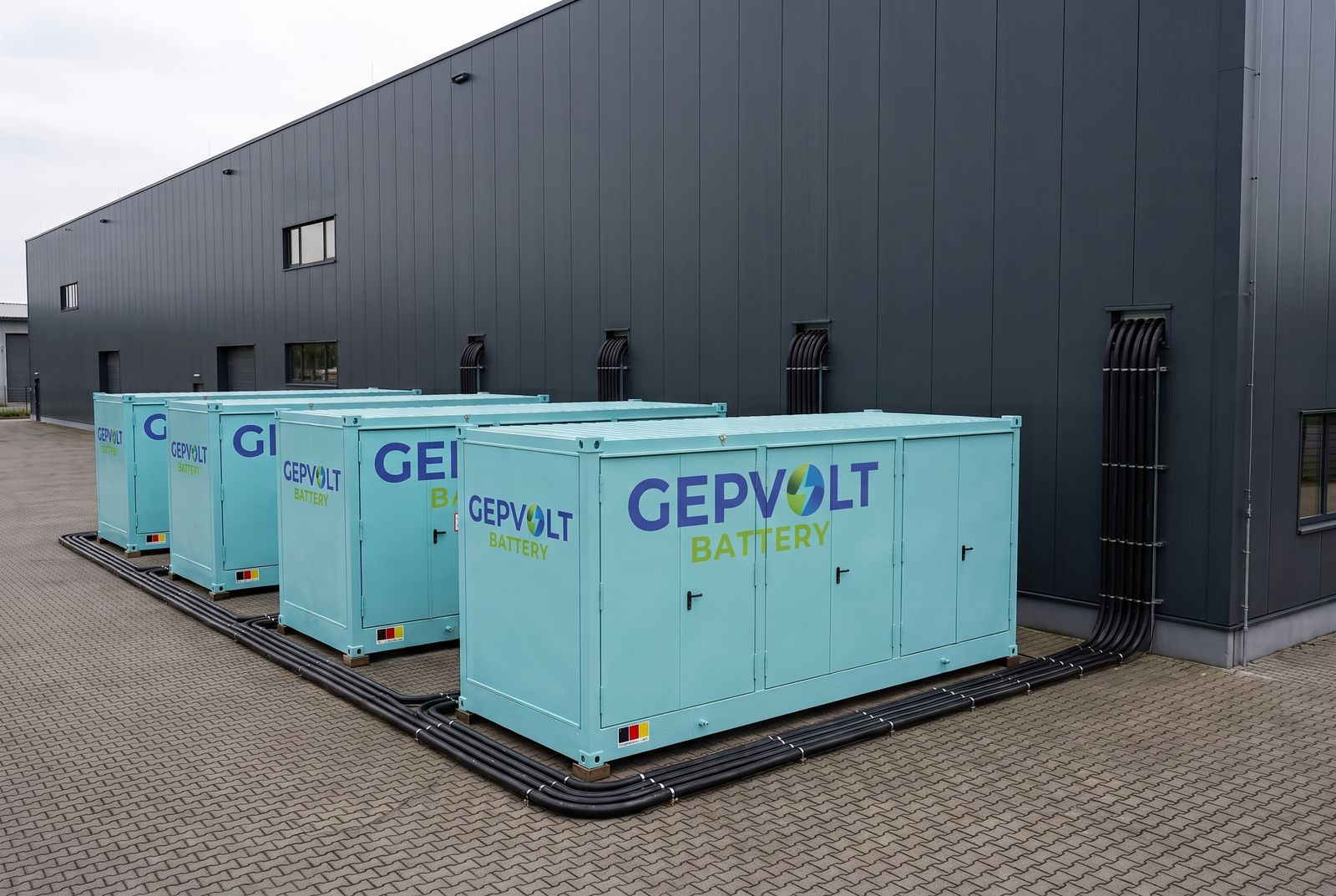
Battery storage for data centres: more power from your existing grid connection

Made in Germany
Engineering, production and service in Germany

Everything from a single source
Planning, engineering, construction and operation

Experienced team
Engineers with years of experience in energy infrastructure

In-house control & EMS
Maximum control and flexibility

Plug & Play
Turnkey, quick to integrate, maximally reliable
Data centres are growing faster than new grid connections can be approved. Battery storage for data centres solves this problem without having to wait for a new or expanded grid connection: it shaves load peaks, provides additional power from its own batteries when needed and increases security of supply - especially where AI workloads cause extreme load peaks. GEPVOLT plans, builds and operates battery storage for AI data centres and conventional data centres alike, designed precisely for the respective load profile - from the initial analysis to ongoing operations management.
Planning storage for production or manufacturing? Battery storage for energy-intensive industry
Starting point
Why the grid connection becomes a bottleneck in data centres
Hardly any infrastructure is currently growing as fast as that of data centres - and hardly any reaches the limits of the available grid connection as quickly. Anyone planning a new data centre or expanding an existing one today will find, in many regions, grid operators who can only provide additional connection capacity after several years. This is where battery storage for data centres provides the decisive time advantage: it makes more efficient use of existing connection capacity, so that the expansion of IT infrastructure is not held back by missing grid commitments.
AI workloads create extreme load peaks
Conventional IT loads in data centres are comparatively steady. AI workloads behave differently: training and inference loads can jump to a multiple of the base load within milliseconds and drop again just as quickly. These load peaks determine the required connection capacity - not the average consumption. A data centre must therefore be designed for peaks that it actually reaches only a fraction of the time.
Connection capacity in MW is scarce and takes years
Whether 5 MW or significantly more: in many grid areas, additional connection capacity is simply not available at short notice. Grid operators have to assess and, if necessary, expand routes, substations and equipment before they can commit to higher capacity. For data centre operators, this means that growth is limited not by customers or hardware, but by the available grid connection capacity.
UPS and load management
Battery storage in the data centre: separating UPS and load management
In most data centres, the uninterruptible power supply (UPS) together with diesel generators provides emergency power. A battery storage system adds a second, economically far more relevant function to this task: load management.

UPS: bridging in the millisecond range
The conventional UPS bridges the period between a power failure and the diesel generators starting up - a window of a few minutes. A battery storage system can also cover this function and responds much faster: it provides power within milliseconds, protecting sensitive server and cooling systems from voltage dips before a generator would even have to start.
Peak shaving and load management in the MW range
The real economic function, however, lies in load management: the storage system absorbs short-term load peaks in the MW range that would otherwise exceed the contractually agreed connection capacity. This means that it is no longer the peak load that is decisive for the grid connection, but the smoothed average load - a crucial difference when sizing the data centre.
Grid connection
Storage instead of grid expansion: more computing power on the same connection
Where expanding the grid connection takes years, a battery storage system creates additional headroom much faster - without the grid operator having to provide new lines or transformer capacity.
Shaving load peaks instead of expanding the grid connection
The storage system is designed to cover exactly those load peaks that exceed the existing connection capacity. As a result, more computing power can be operated on the same grid connection, because sizing is no longer determined by the rare peak but by the smoothed average load.
Reducing grid charges and making electricity costs predictable
A smoothed load curve also affects grid charges, which in many grid areas are based on the highest measured power peak. If this peak is shaved by the storage system, grid charges fall noticeably - an effect that adds up over the life of the installation, lowers overall electricity costs and makes the data centre’s energy consumption more predictable overall.

Technology and safety
Design and safety of the battery storage system
A battery storage system for a data centre is not designed off the shelf, but according to the installation’s actual load profile.
Capacity and cell chemistry according to load profile
The capacity and power of the storage system depend on the level, duration and frequency of the load peaks in the respective data centre. The short but very high load peaks of AI workloads call for different designs than the more even loads of conventional IT: at sites with extreme load changes caused by AI, the battery storage system is deliberately calculated with additional power reserves so that several consecutive load jumps can also be absorbed reliably. The focus of the storage system is on cycle stability and thermal stability in continuous operation. GEPVOLT currently relies on lithium iron phosphate (LFP); the use of sodium-ion cells is planned for the future.
Fire protection and installation of the storage units
Data centres place particularly high demands on fire protection and operational safety. The battery containers are therefore designed with their own fire protection, cooling and monitoring concept and installed in such a way that they do not impair the data centre’s existing safety concepts but complement them. Automated measuring and testing technology continuously monitors voltage and resistance at cell and module level, so that deviations are detected early, before they become a risk to the energy storage system or the connected IT infrastructure.

GEPVOLT develops the battery containers used and their cooling systems itself and manufactures them in Germany. For data centre operators, this means short response times for service and spare parts, as well as an energy storage system whose safety concept comes from a single source - rather than from individual, loosely combined components from different manufacturers.
Process
From load profile to operation of the storage system
GEPVOLT supports data centre operators from the initial analysis to the ongoing operation of the battery storage system - as a single point of contact for the entire system.

Load profile analysis and site assessment
The first step is to evaluate the real load profile: how high are the peaks, how often do they occur, and how much grid connection capacity is available today and in future? Building on this, GEPVOLT assesses the site in terms of space requirements, connection and existing infrastructure.
Depending on the power class, the battery containers require a footprint ranging from a few hundred square metres to one hectare. On sufficiently large plots, the battery storage system can also be combined with a PV installation on the premises in order to store self-generated solar power during the day and further reduce dependence on the public grid - an aspect that is included in the site assessment, even if it is not an option for every data centre.
Planning, grid connection and operations management
This is followed by planning and approval, technical integration at the grid connection point and the assembly and commissioning of the battery containers. During ongoing operation, GEPVOLT takes care of maintenance, monitoring and control of the storage system - tailored to the load peaks of the respective data centre.
Throughout, the data centre operator has a single point of contact for the entire system: from the design of the energy storage solution and the grid connection to operations management. Questions about interfaces between storage, UPS and building management systems are not passed back and forth between several service providers but are clarified directly - a set-up that becomes increasingly important as connection capacity grows and the energy supply becomes more complex.
FAQ
Frequently asked questions about battery storage in data centres
Does battery storage replace the diesel generators in a data centre?
With the appropriate sizing, it can: unlike a conventional UPS battery, which only bridges a few minutes, a large-scale battery storage system can be designed to cover longer power outages as well - entirely without a diesel generator and without the associated maintenance, refuelling and exhaust issues. Whether this is the right solution in an individual case depends on the required backup duration and local regulations; in many cases, the storage system initially complements the existing generators rather than replacing them completely straight away.
How quickly can battery storage be implemented for a data centre?
Much faster than an expansion of the grid connection. Depending on the site and the approval situation, we will give you a specific assessment after the initial site assessment.
How much power does a data centre typically need?
That depends on the load profile. Systems range from a few MW for smaller sites to significantly higher power classes for large, AI-driven data centres.
Can an existing data centre be retrofitted?
Yes. Retrofitting battery storage at an existing grid connection is the most common application, as this is usually where the bottleneck is greatest.
Does the battery storage system also affect the energy supply outside load peaks?
Yes. In addition to shaving load peaks, the storage system can also contribute to the stability of the energy supply outside these phases, for example by cushioning short-term fluctuations in the power grid before they reach the IT infrastructure.
Get in touch
We are here for you and look forward to your message.
