
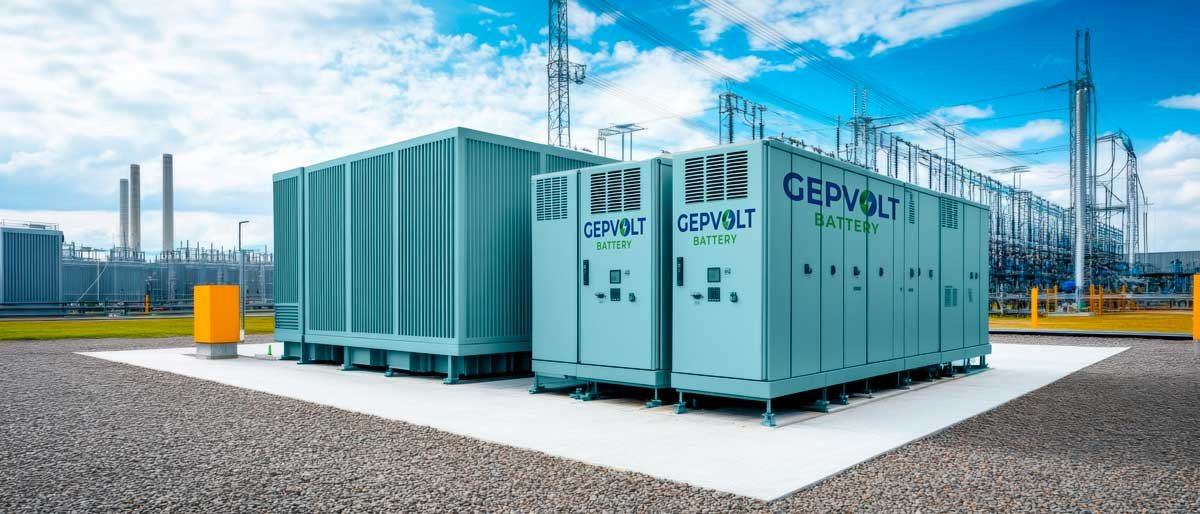
Large-scale battery storage for municipal utilities: secure revenue, stabilise the distribution grid

Made in Germany
Engineering, production and service in Germany

Everything from a single source
Planning, engineering, construction and operation

Experienced team
Engineers with years of experience in energy infrastructure

In-house control & EMS
Maximum control and flexibility

Plug & Play
Turnkey, quick to integrate, maximally reliable
Municipal utilities face a dual mandate: they are expected to guarantee security of supply in their region while remaining economically viable. Battery storage, energy suppliers and municipal utilities increasingly belong together: large-scale battery storage for municipal utilities combines both goals - it stabilises the utility’s own distribution grid and at the same time opens up new revenue from marketing on the electricity market. GEPVOLT handles planning, financing advice, grid connection, construction and operation from a single source.
Many municipal utilities are also the grid operators of their local distribution grid and therefore face a twofold challenge: as grid operators responsible for grid stability and as energy suppliers responsible for commercial returns. It is precisely at this interface that battery storage for energy suppliers delivers its greatest added value: instead of treating grid stability and profitability as separate challenges, a large-scale storage system combines both tasks in a single installation.
Starting point
Why municipal utilities invest in large-scale battery storage
For municipal utilities, electricity storage is no longer just one option among many, but one of the few asset classes that meets regulatory requirements and economic goals at the same time. The legal framework - such as the German Energy Industry Act (EnWG) and the rules on self-supply - gives municipal utilities considerably more scope in choosing an operating model today than just a few years ago, so that such a system can be used economically alongside existing generation assets such as wind or PV parks in their own portfolio.
Additional revenue from existing grid connections and sites
Many municipal utilities already have their own sites with a grid connection - former substations, operating premises or land adjacent to existing infrastructure. This is exactly where electricity storage can be built particularly economically, because the most expensive part of a storage project - the grid connection - is already in place. A previously unused plot thus becomes an additional source of revenue.
Security of supply in your own region
As operators of critical infrastructure, municipal utilities are responsible for security of supply and reliability in their region and their city. A large-scale battery storage system in the utility’s own grid area increases this security because it can step in at short notice when generation and consumption diverge - a contribution that pays off especially in regions with a high share of renewable energy.
Revenue models
Revenue models: how battery storage pays off for municipal utilities
Battery storage for municipal utilities usually opens up several revenue streams at the same time instead of depending on a single source of income.

Arbitrage and direct marketing on the electricity market
Through arbitrage, the storage system buys electricity when it is cheap and sells it when prices rise. In combination with direct marketing, the energy can be placed on the market at the most profitable times - a task that GEPVOLT takes on during ongoing operation or connects to a marketing partner.
Balancing power and ancillary services
In addition, the storage system can provide balancing power and other ancillary services, opening up a second source of revenue that is independent of electricity prices. For municipal utilities, this is an important building block for securing profitability even in market phases with lower price fluctuations. Providing balancing power requires high availability and an energy management system that submits bids on the balancing power market automatically - a task that GEPVOLT can take on during ongoing operation.
Multi-use: several revenue streams from one large-scale storage system
Battery storage for municipal utilities does not have to be committed to a single application. Arbitrage, direct marketing and balancing power can be used in parallel and weighted flexibly depending on market conditions. This multi-use capability is one of the main reasons why large-scale battery storage performs considerably better economically than installations designed from the outset for only one revenue stream. The ongoing optimisation of which applications are served at which time is handled by an energy management system that GEPVOLT provides during operation.
Relieving your own distribution grid
In addition to market revenue, the installation relieves the municipal utility’s own distribution grid: load peaks in its grid area can be absorbed before they lead to congestion or additional grid expansion. This tends to lower grid charges and postpones or avoids investments in grid expansion that would otherwise be necessary. For municipal utilities that are grid operators themselves, this effect feeds directly into the calculation of their own grid charges. Ultimately, households in the supply area also benefit from lower grid charges through relief on their electricity bills. More on grid-supporting operation: Battery storage for grid operators
Financing
Financing battery storage: models for municipal utilities
For many municipal utilities, financing is the decisive question before entering a storage project.
Own investment, co-ownership or leasing of the storage system
Municipal utilities can finance entirely from equity, take a stake in a project as co-owner, or make the land available in return for ongoing lease payments while GEPVOLT acts as operator. Which model is right depends on the utility’s own investment strategy and the desired share in the revenue.
Many municipal utilities also have their own open land or roof areas on which a PV installation can additionally be built. Together, this creates a combined installation: self-generated solar power from the PV installation can be stored temporarily and marketed at the most profitable times instead of being fed into the grid directly and cheaply. For municipal utilities driving the expansion of renewable energy in their own region, this is an additional building block alongside the pure revenue model - even if it is not an option at every site.
Project finance, the bank’s perspective and payback
For conventional project finance, what matters is how robustly the calculated revenues can be presented to financing partners and banks. GEPVOLT provides the design, revenue forecast and technical documentation on the basis of which financing partners can reliably calculate term, interest and payback. The longevity of the modules used is also factored into the calculation of energy costs over the entire term: the longer the modules can charge and discharge stably, the more favourable the payback for the financing partners.
The investment volume of a large-scale storage system is considerable. In order not to bear this risk alone, municipal utilities often share the financing with one or more financing partners - such as their house bank, a specialised fund or a co-investor. GEPVOLT supports this with robust documentation on the revenue forecast, term and technical design, so that financing partners can independently assess profitability. For municipal utilities that also operate their own PV installation, the financing of both parts of the installation can often be bundled, which simplifies negotiations with banks and financing partners and better aligns the terms of the loans.

Process
From site assessment to operations management of the storage system
GEPVOLT supports municipal utilities throughout the entire life cycle - as a single point of contact for planning, approval and operation.

Site analysis and design in MW and MWh
The first step is to assess the site: existing grid connection, available space and the local situation in the power grid. From this, GEPVOLT derives the technical design in MW of power and MWh of capacity, including the number and arrangement of the battery modules required - tailored to the desired revenue models and the requirements for grid relief.
Approval and grid connection of the installation
This is followed by the approval procedure and technical coordination with the responsible grid operator through to the final grid connection. GEPVOLT handles communication with the authorities and the grid operator, so that only the key decisions land on the municipal utility’s desk.
Operation, maintenance and marketing
After commissioning, GEPVOLT takes care of maintenance, monitoring and, depending on the agreed model, marketing on the electricity market - as a consistent point of contact over the entire life of the installation.
References
References: large-scale battery storage in operation

GEPVOLT builds large-scale battery storage in exactly the power class that is relevant for municipal utilities: currently including an 8 MW storage system with 16 MWh capacity in Saxony (Schneeberg project, under construction), a 12 MW storage system with 48 MWh capacity in Brandenburg (Spremberg project, under construction), a 10 MW storage system with 40 MWh capacity in North Rhine-Westphalia and a further 12 MW storage system with 48 MWh capacity in Saxony-Anhalt, both currently in the planning permission phase.
Projects implemented for municipal utilities
The projects mentioned show the range of power classes that GEPVOLT builds - from smaller storage systems to installations in the double-digit MW range. For municipal utilities, this provides comparable design sizes for their own site and project planning, regardless of whether the storage system is built on their own premises or in cooperation with a partner such as GEPVOLT.
FAQ
Frequently asked questions about battery storage for municipal utilities
Is battery storage worthwhile for municipal utilities with smaller grid areas too?
Yes. Profitability depends less on the size of the grid area than on the chosen power class and the revenue streams used. Smaller municipal utilities also use battery storage in the single-digit to low double-digit MW range to good economic effect.
How long does it take to implement a battery storage project for a municipal utility?
Depending on the site, grid connection and approval situation, the period from the initial site assessment to commissioning depends on the individual case. We will give you a specific assessment after the initial site assessment.
Can a municipal utility finance the battery storage system together with an investor?
Yes. Co-ownership models, in which the municipal utility and an external investor share financing and revenue, are one of the common forms of financing alongside full own investment.
Can a municipal utility also market the storage system itself?
Yes, municipal utilities with their own trading access can handle the marketing of the capacity (e.g. arbitrage or balancing power) themselves. In this case, GEPVOLT provides the technical interface so that the utility’s trading system can control the storage system directly. Alternatively, GEPVOLT handles marketing as a full-service offering.
Get in touch
We are here for you and look forward to your message.
