
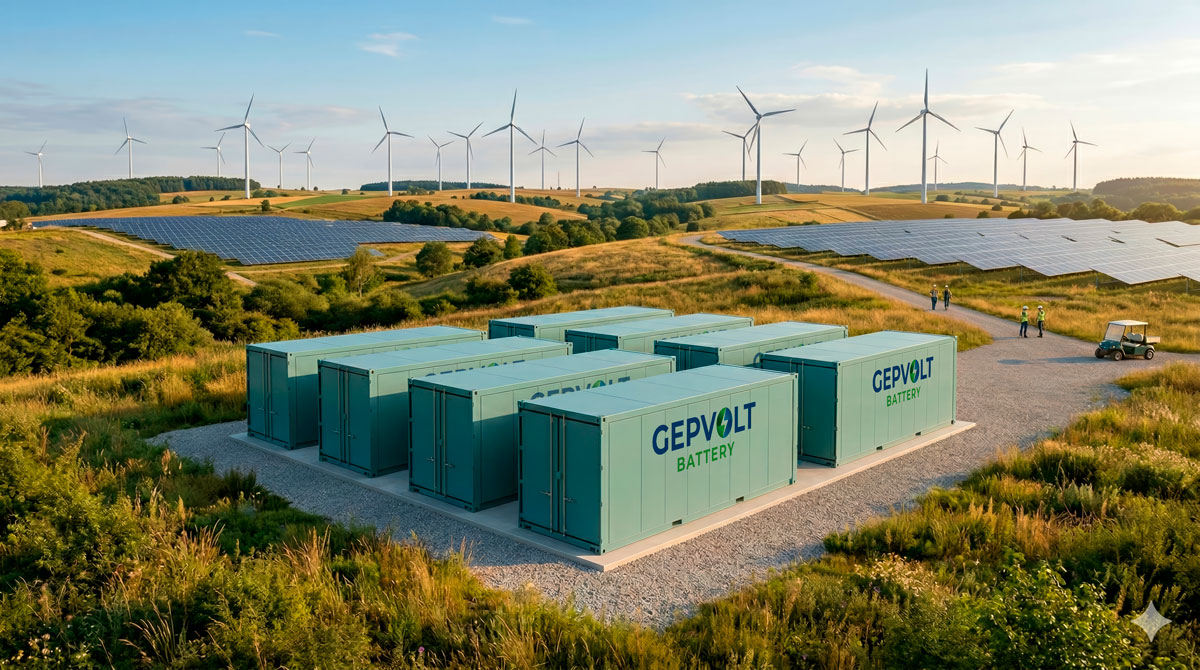
Grid-supporting battery storage: relieve distribution grids instead of expanding them

Made in Germany
Engineering, production and service in Germany

Everything from a single source
Planning, engineering, construction and operation

Experienced team
Engineers with years of experience in energy infrastructure

In-house control & EMS
Maximum control and flexibility

Plug & Play
Turnkey, quick to integrate, maximally reliable
In many distribution grids, the need for additional capacity is growing faster than conventional grid expansion can deliver. A grid-supporting storage system provides relief precisely at the points where the grid reaches its limits, without new lines or an additional substation having to be built straight away. GEPVOLT plans, builds and operates electricity storage for grid operators that is used as an alternative or supplement to conventional grid expansion.
For grid operators, it is crucial that an electricity storage system fits predictably into existing processes: from the grid connection request and registration in the core energy market data register (Marktstammdatenregister) to ongoing operations management. GEPVOLT handles this entire process in accordance with the German Energy Industry Act (EnWG) from a single source.
Grid support
What a grid-supporting storage system achieves in the distribution grid
Not every battery storage system connected to the grid is automatically grid-supporting. For grid operators, what matters most is what the storage system is actually used for.
Grid-supporting and market-driven are not the same
A grid-supporting storage system is used specifically to relieve congestion in the grid, maintain voltage or stabilise frequency, which directly safeguards grid stability. A market-driven storage system, on the other hand, responds primarily to price signals on the electricity market and charges or discharges when it is economically worthwhile. This distinction matters to grid operators because it results in different requirements for control, connection and regulatory classification under the EnWG. In practice, both modes of operation can be combined, as long as grid-supporting use for grid stability takes priority when needed.

Congestion management and peak shaving in the grid
If feed-in from PV and wind installations or the load in a grid section exceeds the available capacity of the power grid, congestion occurs. Such situations are becoming increasingly common in German distribution grids because the priority given to renewable feed-in under the Renewable Energy Sources Act (EEG) concentrates locally at the same grid nodes. A battery storage system at the critical point in the grid absorbs surplus energy or feeds in specifically, thereby shaving the load peaks that would otherwise lead to overload. This congestion management for greater grid stability can be implemented much faster than a conventional expansion of lines or substations.
When electricity storage replaces grid expansion
A grid-supporting storage system replaces grid expansion above all where congestion is temporary and local - for example during individual hours of the year or at specific grid nodes. In such cases, storage is often more economical and much faster to implement than a permanent reinforcement of the grid. Where congestion is structural and permanent, however, grid expansion usually remains unavoidable in the long term; the storage system then bridges the time until completion.
Regulatory framework under the EnWG
Grid-supporting storage operates within its own regulatory framework, which grid operators should be familiar with when planning.
Dual role as generation and consumption installation
Under the EnWG, a battery storage system is treated as both a generation and a consumption installation, as it both feeds in and draws electricity. Among other things, this dual role affects grid charges, metering and billing concepts and registration in the Federal Network Agency’s core energy market data register. GEPVOLT clarifies this classification in line with the EnWG together with the grid operator before the grid connection application is submitted.
Unbundling: what grid operators are allowed to do themselves
The EnWG provides for strict unbundling between grid operation and competitive activities, which is also monitored by the Federal Network Agency. This restricts the role in which a grid operator may itself operate or commercially use a battery storage system. For many grid operators, an operating model in line with the EnWG is therefore relevant, in which GEPVOLT acts as an independent storage partner and provides the installation for grid-supporting purposes to the agreed extent, without affecting the unbundling requirements under the EnWG.
Grid connection and construction cost subsidy (BKZ)
Technical integration is preceded by clarification of the grid connection and the associated construction cost subsidy (Baukostenzuschuss, BKZ).
Flexible grid connection agreements
Instead of a rigid connection with firmly guaranteed capacity, flexible grid connection agreements are increasingly being used for large-scale storage. Here, the storage system’s feed-in or withdrawal capacity is limited in certain situations when grid stability requires it. This can make connection capacity available faster than a fully unrestricted connection capacity would allow.
Distinction in the connection procedure
The German Power Plant Grid Connection Ordinance (KraftNAV) governs the grid connection of installations of 100 MW and above to grids of at least 110 kV. At 1 to 12 MW, GEPVOLT’s storage systems are well below this threshold, so the KraftNAV does not apply to them. The distinction is nevertheless relevant for grid operators: the orderly connection procedure of the KraftNAV, with fixed deadlines and reserved grid capacity, can serve as a guide even for smaller storage systems, although these do not legally fall under the KraftNAV. GEPVOLT therefore clarifies early on with the grid operator which connection procedure applies should a project grow into the KraftNAV size range.
Connection level and construction cost subsidy
The appropriate connection level depends on the power and location of the storage system: smaller installations are often connected at medium-voltage level, larger storage systems directly at the substation. The construction cost subsidy (BKZ) depends on the connection level and capacity. The exact amount of the BKZ is determined individually by the grid operator. GEPVOLT submits the complete BKZ application to avoid delays in the grid connection.
Potential analysis
Assess grid-supporting use at your site
Together with you, we analyse where a battery storage system can relieve congestion in your grid area and usefully complement grid expansion.
Integration
Integrating storage technically into the existing grid
Once the connection level and BKZ have been clarified, the technical design of the storage system follows.
Power from 1 to 12 MW, capacity up to 48 MWh
GEPVOLT builds grid-supporting battery storage systems with a power range of 1 to 12 MW and a capacity of up to 48 MWh. The specific design is based on the extent and duration of congestion in the respective grid section and on the available connection capacity.
Control and operating mode in grid operation
A grid-supporting storage system requires a control system that responds to signals from grid operation rather than running purely on market prices. For this purpose, GEPVOLT uses its own energy management system, which links the storage system’s operating mode to predefined grid states and ensures the agreed grid-supporting priority. GEPVOLT develops and manufactures the battery storage systems itself in Germany.

Ancillary services from battery storage
In addition to relieving congestion, a battery storage system provides further ancillary services.

Frequency stabilisation and balancing power
Battery storage systems respond to deviations in grid frequency within seconds and provide balancing power for this purpose. This fast response time makes them particularly suitable for frequency stabilisation compared with conventional power plants, which regulate much more slowly.

Voltage control and reactive power
By providing reactive power, a battery storage system also supports voltage control in the grid. This is particularly relevant in grid sections with a high share of renewable feed-in, where voltage fluctuations would otherwise occur more frequently.
Collaboration
Working with GEPVOLT as your storage partner
GEPVOLT supports grid operators from site assessment to ongoing operation of the storage system.

Site assessment and design of the storage system
The first step is a joint assessment of the grid node at which a storage system offers the greatest grid-supporting benefit, and the design of power and capacity for this specific need. Information on the frequency of congestion, the BKZ calculation and the connection situation is brought together in the process.
Implementation, operation and operations management
After local building approval and registration with the Federal Network Agency, GEPVOLT handles construction, commissioning and ongoing operations management of the storage system, including maintenance and monitoring of the grid-supporting operating mode.
FAQ
Frequently asked questions about grid-supporting storage
Does a grid-supporting storage system require approval?
As a rule, yes. In addition to building approval, where required, registration in the Federal Network Agency’s core energy market data register is always mandatory. GEPVOLT handles this process from application to final registration with the Federal Network Agency.
How quickly can congestion be relieved with a battery storage system?
After grid connection and commissioning, the storage system responds to congestion situations within seconds. The time until commissioning depends on the site, grid connection and approval situation.
Does the grid operator have to finance the storage system itself?
No. In the model with GEPVOLT as storage partner, GEPVOLT takes on the investment, construction and operation of the installation; the grid operator uses the grid-supporting effect as contractually agreed.
How does a grid-supporting storage system differ from storage in the municipal utility model?
A grid-supporting storage system is used primarily for the stability of the upstream grid, whereas storage in the municipal utility model (see Battery storage for municipal utilities) additionally serves its own commercial revenue streams.
Get in touch
We are here for you and look forward to your message.